

🔰 Introduction
The electric vehicle (EV) industry has become one of the fastest-growing markets of the decade.
After Tesla’s success, several new players entered the field — and one name that caught global attention is Rivian Automotive Inc. (Ticker: RIVN).
The company started with massive hype and strong backers like Amazon and Ford, but today, its stock trades over 90% below its IPO highs.
So, is Rivian Stock a long-term opportunity or a financial trap for investors? Let’s dive in.
The Rivian Stock has become a topic of great debate among EV investors.
Since its IPO, Rivian Stock has witnessed huge ups and downs in the electric vehicle market.
🏭 Company Background
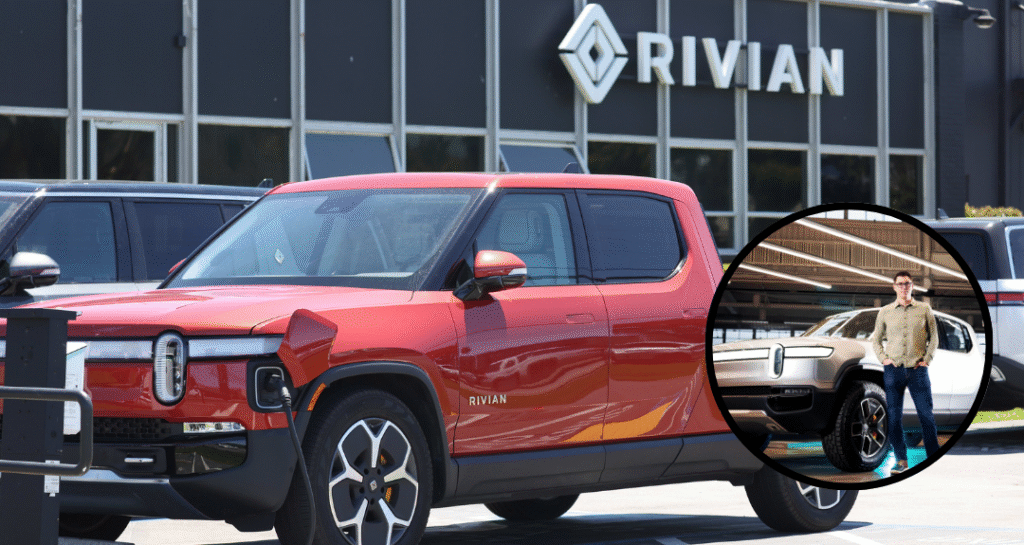
Rivian was founded in 2009 by RJ Scaringe, headquartered in Irvine, California.
Its mission: to build adventurous, sustainable electric vehicles that inspire the world to explore responsibly.
Core Models:
- R1T: All-electric pickup truck
- R1S: Electric SUV built on the same platform
- EDV (Electric Delivery Van): Designed exclusively for Amazon’s delivery network
Rivian attracted early investments from Amazon and Ford Motor Co., giving it credibility and funding power.
When the company went public in 2021, it briefly reached a $100 billion USD valuation — making it one of the biggest EV IPOs in history.
📉 Rivian Stock Current Market Situation (2025)
According to November 2025 data:
- Rivian Stock price: ≈ $16.66 USD
- Market Cap: around $15 billion
- 52-week range: $15 – $30 USD
- Decline from IPO high: ~ 91%
The steep fall has been driven by:
- Rising production costs
- Delivery delays
- Increased competition from Tesla, BYD, and Lucid
- Weak investor confidence
💡 Key Shareholders and Partnerships
Amazon remains Rivian’s largest institutional investor, and it initially ordered 100,000 electric vans for its logistics fleet.
However, changes in Amazon’s delivery strategy have slowed order volumes.
Ford Motor Company, another early backer, partially exited its position — signaling reduced strategic alignment.
That exit shook investor sentiment, raising concerns about Rivian’s long-term financial backing.
⚙️ Production & Expansion
Rivian currently operates a major manufacturing facility in Normal, Illinois, with plans for a new $5 billion plant in Georgia, expected to be operational by 2026.
This expansion could double output capacity but also requires massive capital.
For 2025, the company reported a net loss of $3.5 billion USD, keeping it in negative earnings territory for the fifth straight year.
💬 CEO RJ Scaringe’s Compensation Move
In November 2025, Rivian’s board approved a $4.6 billion pay package for CEO RJ Scaringe — largely stock-based incentives tied to future profitability targets.
While supporters view this as a long-term confidence signal, critics argue it’s premature given Rivian’s losses.
This controversy has further polarized investor opinion.
📊 Rivian Stock Financial Overview and Performance
| Year | Revenue | Net Profit/Loss | Avg Share Price |
|---|---|---|---|
| 2021 | $55 M | -$4.6 B | ≈ $100 |
| 2022 | $1.6 B | -$6.8 B | ≈ $35 |
| 2023 | $4.1 B | -$4.3 B | ≈ $25 |
| 2024 | $5.3 B | -$3.7 B | ≈ $18 |
| 2025 (Q3) | $3.9 B | -$2.1 B | ≈ $16 |
Despite growing revenue, Rivian remains unprofitable.
The path to break-even depends on cutting costs and scaling production efficiently.
🔍 Rivian vs Tesla vs Lucid vs BYD
| Company | Market Cap | Flagship Model | Strength | Challenge |
|---|---|---|---|---|
| Tesla | $750 B | Model Y, 3 | Global brand & profits | Rising competition |
| Rivian | $15 B | R1T, R1S | Innovative EV trucks | High losses |
| Lucid | $9 B | Air | Luxury EV segment | Weak demand |
| BYD | $100 B | Atto 3, Seal | Strong China presence | Limited US reach |
Rivian’s focus on electric pickup trucks gives it a unique niche, but it must reach mass-production scale to compete effectively.
💹 Market Sentiment
Analyst ratings (Nov 2025):
- Bank of America: Underperform
- JP Morgan: Neutral
- Goldman Sachs: Hold
- Morgan Stanley: Overweight (Long term positive)
Experts agree Rivian has strong engineering potential but needs more time and financial discipline before it can achieve profitability.
🌿 Challenges Facing the EV Industry
- Rising battery material costs (lithium & nickel)
- Supply-chain pressure post-pandemic
- Reduced government EV tax credits in some regions
- Aggressive competition from Chinese and European automakers
These macro challenges make it harder for Rivian to sustain growth without burning cash.
💰 Investment Opportunities vs Risks
✅ Opportunities
- First-mover advantage in the electric pickup segment
- Long-term Amazon partnership
- New Georgia plant to boost output
- Strong eco-friendly brand image
⚠️ Risks
- Persistent losses and high expenses
- Dilution risk from future capital raises
- Competitive pressure from Tesla and BYD
- Weak short-term investor sentiment
🔮 Rivian Stock Future Outlook (2026 and Beyond)
Rivian aims to achieve profitability by 2026.
If production efficiency improves and demand remains stable, Rivian could become a key EV player alongside Tesla and BYD.
However, this will require disciplined cost control, successful factory expansion, and sustained investor confidence.
🧠 Investor Takeaway
For long-term investors with high risk tolerance, Rivian Stock could be an opportunity to accumulate at lower levels.
Yet, short-term traders may find it volatile due to uncertain quarterly results.
Always consult a licensed financial advisor before making investment decisions.
🔚 Conclusion
Rivian Stock symbolizes both the ambition and struggle of the new EV era.
It began with huge potential but now faces the tough reality of scaling production, managing losses, and maintaining credibility.
If Rivian can deliver on its promises, it could emerge as a dark horse of the EV market.
Until then, investors should approach it with caution — balancing optimism with prudence.