
A Chilling Turn of Events in the Delhi Blast Case
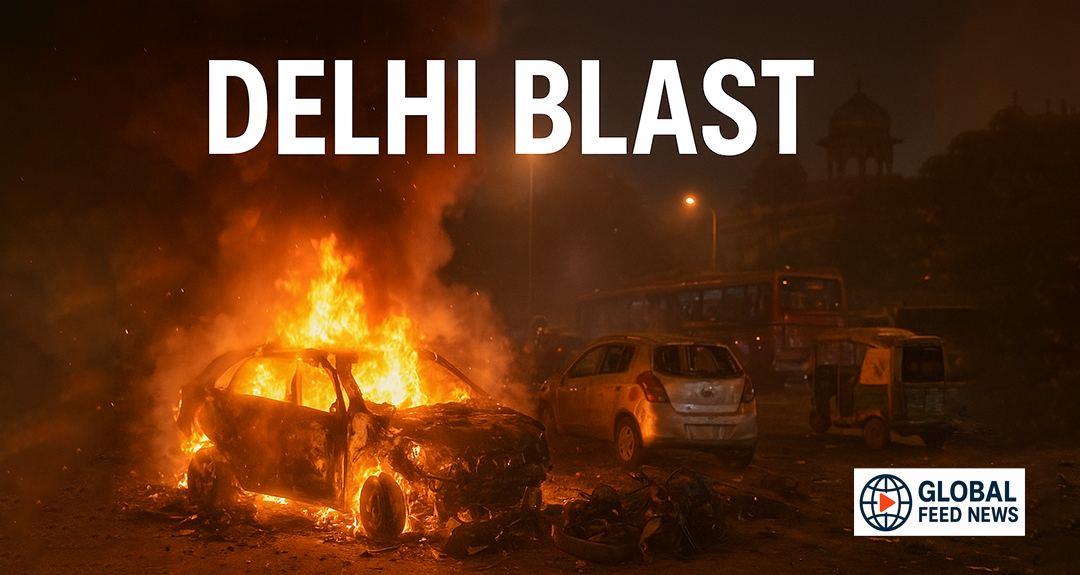
New Delhi: The capital city was shaken by a massive Delhi Blast near the historic Red Fort, killing nine people and injuring several others. What initially appeared to be a tragic accident has now been confirmed as a terrorist attack, unraveling a web of radicalized professionals operating under what authorities call a “white-collar terror module.”
The explosion occurred late Monday night when a slow-moving vehicle stopped at a traffic light near Red Fort and suddenly detonated, setting nearby vehicles ablaze. Witnesses described scenes of chaos, flames, and screams as the explosion shattered the calm of one of Delhi’s busiest and most historic areas.
Link to Pulwama-Based Doctor and the Terror Module
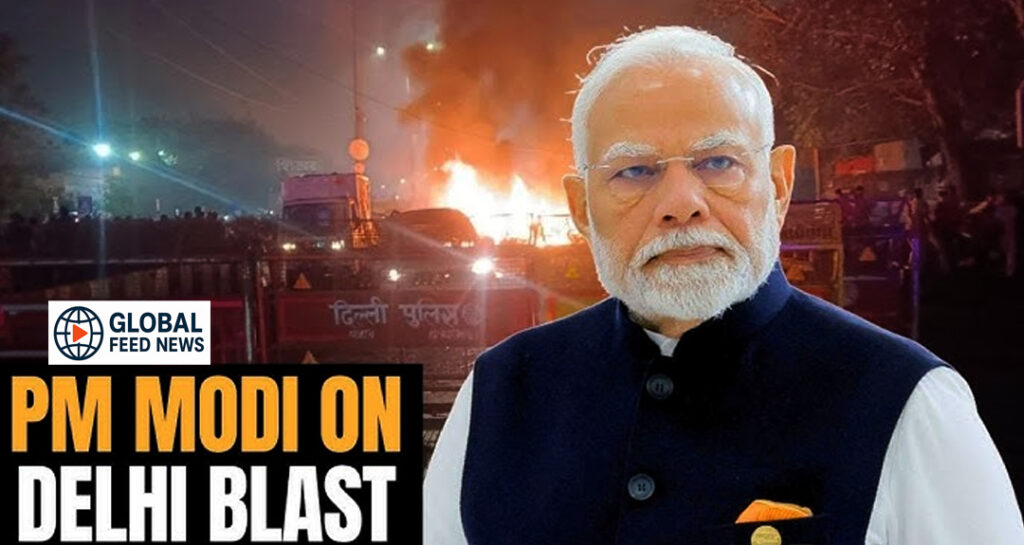
Early investigations by the Delhi Police, in coordination with Jammu and Kashmir Police and Haryana Police, revealed a chilling link to Pulwama in South Kashmir. The car in which the Delhi Blast took place was owned by Dr Umar Mohammad, a doctor from Pulwama who has now been identified as a part of a larger terror network.
According to top sources, Dr Umar was directly associated with Dr Muzammil Shakeel and Dr Adil Rather, both medical professionals arrested earlier in Faridabad, Haryana. These men were allegedly key members of a module that had been under police surveillance for over 26 days. The arrest of Shakeel and Rather, and the seizure of over 2,900 kilograms of suspected explosives, appears to have triggered Umar’s panic, leading him to detonate the vehicle near Red Fort.
Delhi Blast Now Treated as a Terror Attack
The Delhi Police have officially categorized the Delhi Blast as a terrorist act under the Unlawful Activities (Prevention) Act (UAPA).
- Sections 16 and 18 of UAPA — dealing with acts of terrorism and related punishments — have been invoked.
- Additionally, Sections 3 and 4 of the Explosive Substances Act, along with charges of murder and attempt to murder, have been added.
Officials suspect that a large quantity of ammonium nitrate was used in the explosion — a substance commonly used in fertilizers but capable of producing devastating blasts when combined with fuel oil or other chemicals. The similarity between the materials recovered in Faridabad and those used in the Delhi Blast further strengthens the link between the module and the attack.
Explosives Seized in Faridabad: The Lead That Unfolded Everything
The investigation took a major turn when Jammu and Kashmir Police and Haryana Police jointly raided two houses in Faridabad, rented by Dr Muzammil Shakeel. The raids, which occurred just hours before the Delhi Blast, uncovered:
- 350 kilograms of high-intensity explosives,
- 20 timers and detonators,
- Several assault rifles, handguns, and ammunition,
- Over 2,563 kilograms of additional bomb-making materials, suspected to be ammonium nitrate.
This massive haul, totaling nearly 2,900 kilograms, is believed to be one of the largest seizures of explosives in northern India in recent years. The properties had been rented by Shakeel for over three years, indicating long-term planning and sophisticated concealment.
How the Module Operated: The ‘White-Collar’ Network
Investigators have described the busted group as a “white-collar terror module” — a network of educated, professional individuals, including doctors, engineers, and other specialists, who were radicalized and trained by handlers based in Pakistan and the Middle East.
These individuals used their professional identities and clean social profiles to operate undetected. According to intelligence reports, they were involved not only in bomb-making but also in propaganda activities, such as pasting posters supporting terror outfits, transferring funds through legitimate banking channels, and recruiting others into extremist ideologies.
The module’s members reportedly maintained communication via encrypted messaging platforms and used coded terminology to avoid detection. Sources say that their radicalization had been gradual, taking place over several years.
Vehicle Chain and Ownership Trail
The car involved in the Delhi Blast had a complicated ownership history. Investigators traced its chain of possession through three individuals:
- Aamir, the original owner,
- Tariq, the second owner, and
- Dr Umar Mohammad, the final owner and alleged executor of the blast.
Police have already detained Tariq in Pulwama for questioning. Forensic teams are analyzing the car’s remains, while digital experts are examining call records, location data, and payment trails to establish the exact timeline of transactions.
Scenes from the Blast Site
The area surrounding Red Fort and Chandni Chowk, among the most crowded parts of Delhi, witnessed horrifying scenes after the explosion. Mangled cars, shattered glass, and burnt-out rickshaws lined the streets as rescuers and bystanders rushed to help victims.
According to Delhi Police Commissioner Satish Golcha, “A slow-moving vehicle stopped at a red light, and an explosion occurred inside that vehicle. Nearby vehicles caught fire due to the intensity of the blast.”
Six vehicles were completely gutted, and several others were damaged by the shockwave. Emergency teams worked overnight to clear debris, collect forensic samples, and identify the victims.
The National Investigation Expands
The scale of the Delhi Blast and its links across multiple states have prompted the formation of a multi-agency task force.
The joint investigation now includes:
- Delhi Police Special Cell
- Jammu & Kashmir Police
- National Investigation Agency (NIA)
- National Security Guard (NSG)
- Intelligence Bureau (IB)
- Uttar Pradesh ATS
- Haryana and Gujarat Police
- Central Forensic Teams
The NIA is expected to take formal charge of the case soon, given the inter-state and terror-related dimensions. Early forensic findings suggest that the blast pattern and explosive residue match ammonium nitrate-fuel oil (ANFO) type bombs, often used by terror groups in South Asia.
26 Days of Surveillance: How Police Tracked the Module
According to Jammu & Kashmir Police sources, the module led by Dr Muzammil Shakeel had been under watch for nearly a month. The group had rented multiple properties across Srinagar, Anantnag, Ganderbal, Shopian, and Faridabad.
For 26 days, intelligence teams tracked suspicious material shipments and online transactions linked to the suspects. When the Faridabad raids were finally conducted, the discovery of massive explosives confirmed their fears — but before the entire module could be detained, the Delhi Blast took place, likely as an act of desperation.
Government Response and National Security Measures
Home Minister Amit Shah, speaking late Monday night, stated that “no possibility can be ruled out.” He assured that all aspects — including terrorist networks, cross-border connections, and funding routes — are being thoroughly investigated.
Delhi has since been placed on high alert, with intensified security checks at all major government buildings, transport hubs, and tourist landmarks. The Red Fort and Chandni Chowk areas are being continuously monitored by drones and CCTV surveillance teams.
The Ministry of Home Affairs has also directed the NIA and IB to fast-track intelligence gathering on possible sleeper cells operating in northern India, especially those involving professionals under the guise of legitimate employment.
Experts Warn of Rising ‘Educated Extremism’
Counter-terrorism experts warn that the Delhi Blast highlights a dangerous trend — the rise of educated extremists who exploit their professional status to advance terrorist goals. These individuals, often well-integrated into society, are harder to detect than traditional terror operatives.
Former RAW officer Raman Sharma commented that “white-collar terror poses a unique challenge because it blends sophistication with ideology. Doctors, engineers, and IT professionals have the skills to create and conceal high-impact operations.”
Security analysts believe that this attack could mark a shift in how extremist organizations operate in India, focusing more on covert, intelligence-driven operations rather than overt militant activities.
Conclusion: A Wake-Up Call for National Security
The Delhi Blast near Red Fort stands as a grim reminder that terrorism in the modern era is not limited to rural training camps or foreign infiltrations — it can grow quietly within educated circles, disguised by credentials and careers.
As investigations continue, authorities are determined to dismantle the remaining networks of this white-collar terror module, trace their funding sources, and identify their handlers abroad.
While the city mourns the lives lost in the Delhi Blast, the incident also underscores the urgent need for enhanced intelligence cooperation, public vigilance, and digital surveillance reforms to counter the evolving face of terrorism in India.