
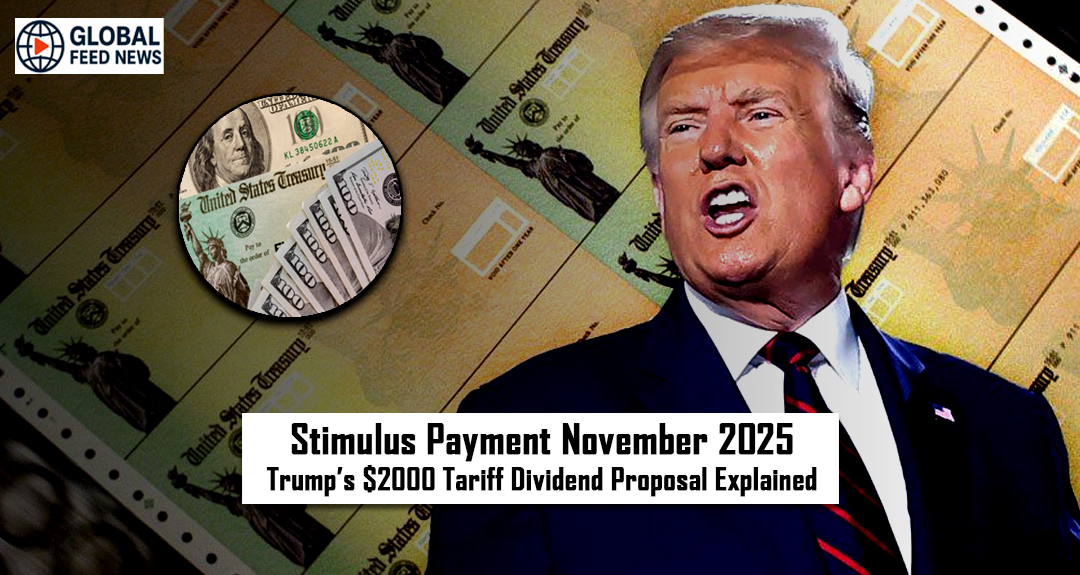
Washington D.C.: In a bold economic announcement that has sparked national debate, former U.S. President Donald J. Trump has proposed a new Stimulus Payment November 2025 — a $2,000 payment for most eligible Americans. The funds, branded as a “tariff dividend,” would be financed from import tariffs imposed earlier this year, marking one of the most unconventional stimulus ideas in recent memory.
🔹 What Is the Stimulus Payment November 2025?
According to Trump’s public statement on November 9, 2025, the administration plans to distribute a direct payment of at least $2,000 per person, excluding high-income earners. He described the initiative as a way to “return money collected from foreign countries back to hardworking Americans.”
The plan is still under development, but Trump’s post on his social media platform stated:
“A dividend of at least $2,000 a person (not including high-income people!) will be paid to everyone.”
The announcement quickly gained traction on social media and major outlets such as CNN, Time, and The Guardian, all describing it as a potential stimulus payment in November 2025.
🔹 Why Now? The Political and Economic Context
The proposal arrives amid rising inflation pressures and declining consumer confidence. Trump’s economic team claims the U.S. government has collected substantial revenue from new tariffs on imported goods, especially from China and Europe. Those revenues, they argue, can fund both the direct payment and national debt reduction.
Political analysts suggest this move is also a strategic play to regain voter support. A $2,000 check could appeal to lower- and middle-income households still struggling with higher prices post-pandemic.
Tariff Revenue as Funding
According to preliminary Treasury data, total tariff revenue in 2025 may exceed $190 billion. However, net usable revenue after offsets and trade adjustments may be significantly lower — closer to $90 billion. That’s well below the estimated $300 billion required to fund $2,000 payments to roughly 150 million Americans.
Legal Uncertainty
Critics point out that the tariffs funding this proposal are currently under review by the U.S. Supreme Court. If justices strike down Trump’s emergency tariff powers, the plan’s funding mechanism could collapse entirely.
🔹 How Would the Stimulus Payment Work?
- Proposed Amount: $2,000 per person.
- Exclusions: “High-income earners” (no official income limit announced).
- Payment Type: Could be a direct deposit, mailed check, or tax credit.
- Funding Source: Tariff revenues collected from imports.
- Timeline: Targeted for November 2025, though not finalized.
Trump’s Treasury Secretary, Scott Bessent, noted that the “dividend” could take several forms — from one-time checks to ongoing tax relief. No legislation has been passed yet, meaning the plan is currently aspirational.
🔹 Who Could Qualify for the Stimulus Payment?
Eligibility remains one of the biggest unknowns. The term “high-income people” has not been defined. Based on past stimulus programs, experts speculate the cutoff could be around $75,000 for individuals or $150,000 for couples, similar to the 2021 pandemic relief checks. Children and dependents’ eligibility is also unconfirmed.
🔹 Economic and Social Impact
Short-Term Boost
If the Stimulus Payment November 2025 is implemented, it could offer a temporary spending boost, especially for lower-income families. Retail, hospitality, and e-commerce sectors might benefit most as consumer demand rises.
Inflation Concerns
Some economists warn that fresh stimulus spending may worsen inflation, particularly if supply chain costs rise due to tariffs. The U.S. Federal Reserve would likely monitor inflation data closely before endorsing any fiscal injection of this scale.
Debt Implications
While the administration claims the dividend won’t add to the national deficit, economists argue that diverting tariff revenue from debt repayment could still affect long-term fiscal health. The U.S. debt currently exceeds $34 trillion, and critics question whether the government can sustain such payouts.
🔹 Legal and Political Challenges Ahead
The Stimulus Payment November 2025 concept faces two immediate hurdles:
- Legal Approval: The Supreme Court must first uphold the tariff program’s legality. If the court overturns it, the funding stream disappears.
- Congressional Approval: Any nationwide payment program requires congressional authorization, which could face partisan gridlock.
Democratic lawmakers argue the plan lacks transparency and sustainability. Meanwhile, some Republican fiscal conservatives question whether tariffs can truly generate enough money without harming U.S. consumers.
🔹 What Experts Are Saying
Economists remain divided. Supporters call it a “creative redistribution” of tariff gains, while critics view it as election-year populism.
“The math doesn’t add up. The U.S. would need far more tariff revenue than it currently collects,” said a Brookings Institution analyst.
Others counter that even a smaller dividend could still have symbolic and psychological value, boosting public confidence in the economy.
🔹 The SEO & Media Impact of “Stimulus Payment November 2025”
The phrase itself has exploded in search traffic. Americans are Googling terms like “Trump $2000 stimulus,” “tariff dividend check,” and “stimulus November 2025.” News outlets are framing it as a “fourth stimulus” scenario, even though no law exists yet.
For digital publishers, using the keyword stimulus payment November 2025 in headlines, subheads, and meta descriptions can significantly improve content reach. Readers are actively searching for updates, eligibility rules, and timelines — creating high engagement potential.
🔹 What Happens Next?
- Supreme Court Decision: A verdict on tariff authority is expected within weeks.
- Legislative Drafts: Congress may introduce bills to define eligibility and payment logistics.
- Treasury Updates: Official revenue reports will clarify whether funding targets are realistic.
- Public Announcements: Watch for official White House or Treasury briefings by late November.
Until then, the “stimulus payment” remains a proposal — not a confirmed program. Americans are advised to follow verified government updates before making financial plans based on it.
🔹 Final Thoughts
The proposed Stimulus Payment November 2025 — a $2,000 “tariff dividend” funded by import duties — represents an ambitious intersection of economic policy and political strategy. It promises relief but faces serious legal, fiscal, and logistical barriers.
Whether it becomes reality or remains campaign rhetoric, the proposal underscores a growing demand for tangible financial support amid persistent economic uncertainty.
Stay tuned to Global Feed News for real-time updates on the U.S. stimulus proposal and global economic trends.
2 thoughts on “Stimulus Payment November 2025: Trump’s $2000 Tariff Dividend Proposal Explained”